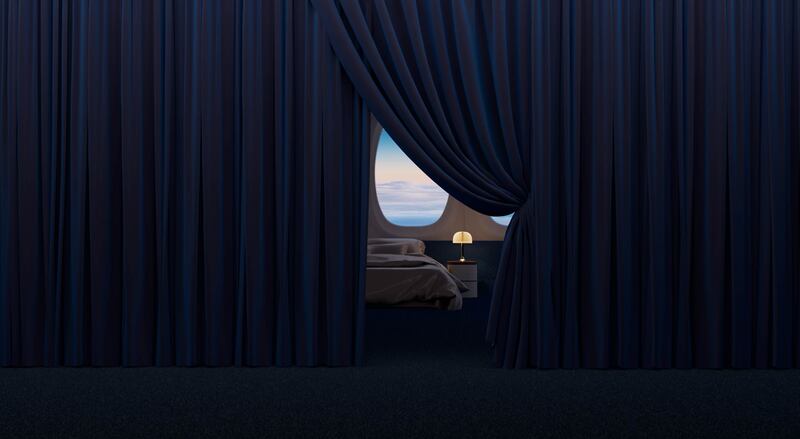
Rethinking experience through small choices
Between fairs saturated with stimuli and repetitive discourses on innovation, there are spaces that refuse immediate impact and choose to operate in a more demanding territory: that of the question. That was what we encountered during our recent visit to Maison et Objet, in an installation that began to provoke thought long before it revealed itself.
Conceived by Rudy Guénaire, a key figure at the intersection of hospitality, narrative, and contemporary experience. Known for his cinematic approach to space and his refusal of obvious solutions, Guénaire brought a vision that goes beyond interior design, subtly and rigorously questioning the sector’s ingrained automatisms.
It was called Suite 2046.
The most relevant element of the installation was not, in fact, the room, but the journey towards it. A corridor conceived as a zone of friction, where the visitor was confronted with minimal, almost invisible decisions that are nonetheless structurally decisive in the contemporary experience of hospitality.
There appeared objects familiar to any hotel. Slippers, towels, drinks, flowers. Elements so normalised that they have ceased to be questioned. And it was precisely within this automatism that the installation operated.
Why do we continue to offer disposable, rigid, uncomfortable slippers when we know that the first physical contact with a space often happens through the feet. Why do we insist on high quality towels only to then instruct the guest to place them on the floor after a single use. We speak of care, yet we design rituals of disposal.
Even water was reconsidered. Instead of the habitual neutral and undervalued bottle, the suggestion was coconut water. A simple gesture. Flowers introduced another layer of ambiguity: natural or artificial.
Before reaching the room, the visitor had already been led to understand that the future of hospitality is not decided through grand technological gestures, but through these everyday micro choices that shape real experience.
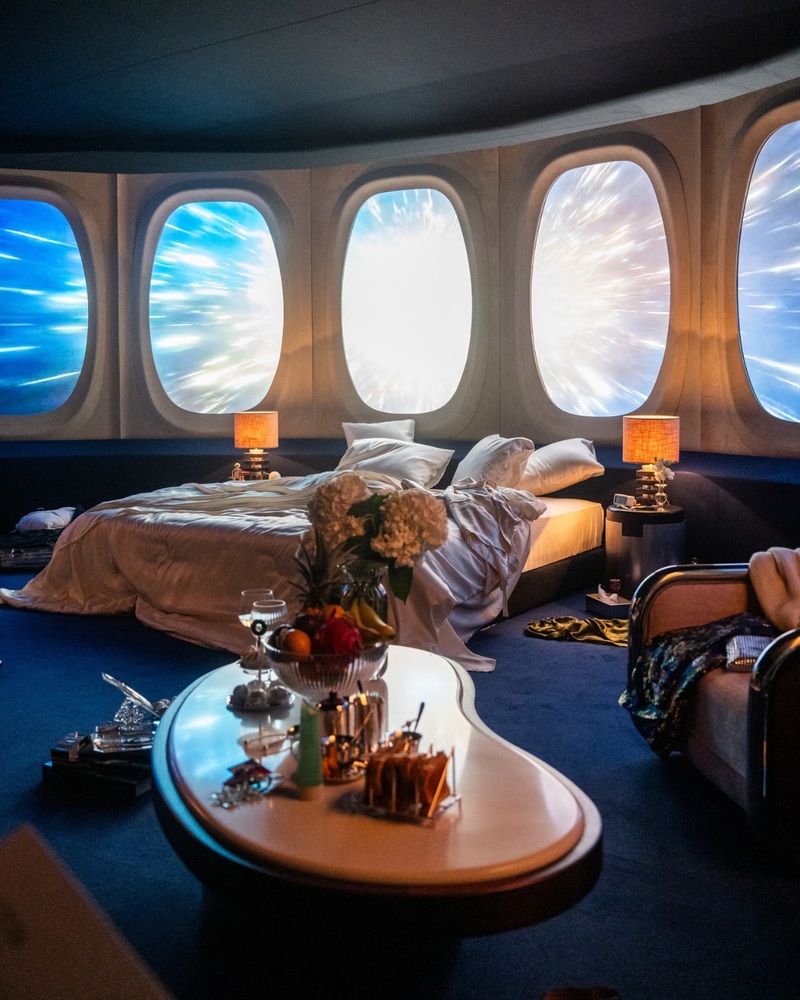
Only then did one enter the suite. And here the language became quieter and more precise. The chromatic base was a deep, dark blue, almost nocturnal, absorbing the gaze and creating visual restraint. The pieces related to one another through materiality: thick glass, chromed metals, porcelain, scented candles. Everything was chosen, nothing appeared accumulated. The room felt lived in, not as an idealised set, but as an inhabited space. Objects arranged for real use rather than for photography. The intention was not to present possibilities, but to sustain an atmosphere.
For those who work in the world of events, this installation is particularly uncomfortable because it shifts the focus to where we rarely look. It forces us to reconsider the kinds of decisions we make daily without critical reflection.
How often do we choose a napkin solely for its colour or its photographic performance, ignoring touch, weight and how it behaves in the hand. How often do we select a tablecloth for the aesthetic of the fabric while neglecting the quality of the hem, its thickness, the way it falls and responds to movement. Suite 2046 reminds us that sophistication does not reside only in what is seen, that experience is built through sensory layers that are often invisible. Bringing this logic into events is not about copying an aesthetic, but about deepening our choices. Questioning every automatic decision, replacing repetition with intention, treating every element, from textiles to the smallest object, as an active part of the narrative rather than mere visual filler.
The future of experiences does not lie in doing more, but in doing with greater awareness, in accepting that the quality of detail, when taken seriously, has more impact than any scenographic excess. In designing events that do not live solely through image, but through the bodily memory they leave behind.
Suite 2046 did not propose a spectacular future, but an attentive one. And in a sector accustomed to confusing impact with quality, that attention is today one of the most demanding forms of creation.
It is this reading that we carry with us. And it is from this perspective that we continue to think about experiences where every choice, even the most discreet, carries weight, intention and consequence.